

Graduate Interview, Hanna Seymour
Can Seminary Fit an Already Full Life?
Hanna Seymour wanted deeper biblical and theological training for her work as an author and Bible teacher. What she did not know was whether seminary could fit into a life that already included work, ministry, homeschooling, and three young children.
It did.
By developing a consistent study rhythm, working ahead before her mentoring terms, and using mentor meetings to revisit and reinforce what she had learned, Hanna completed her M.A. in Biblical Studies while continuing the work and family responsibilities already entrusted to her.
“I didn’t think I ever thought I’d be able to fit it in while I had three kids under three and a half years old, but here we are.”
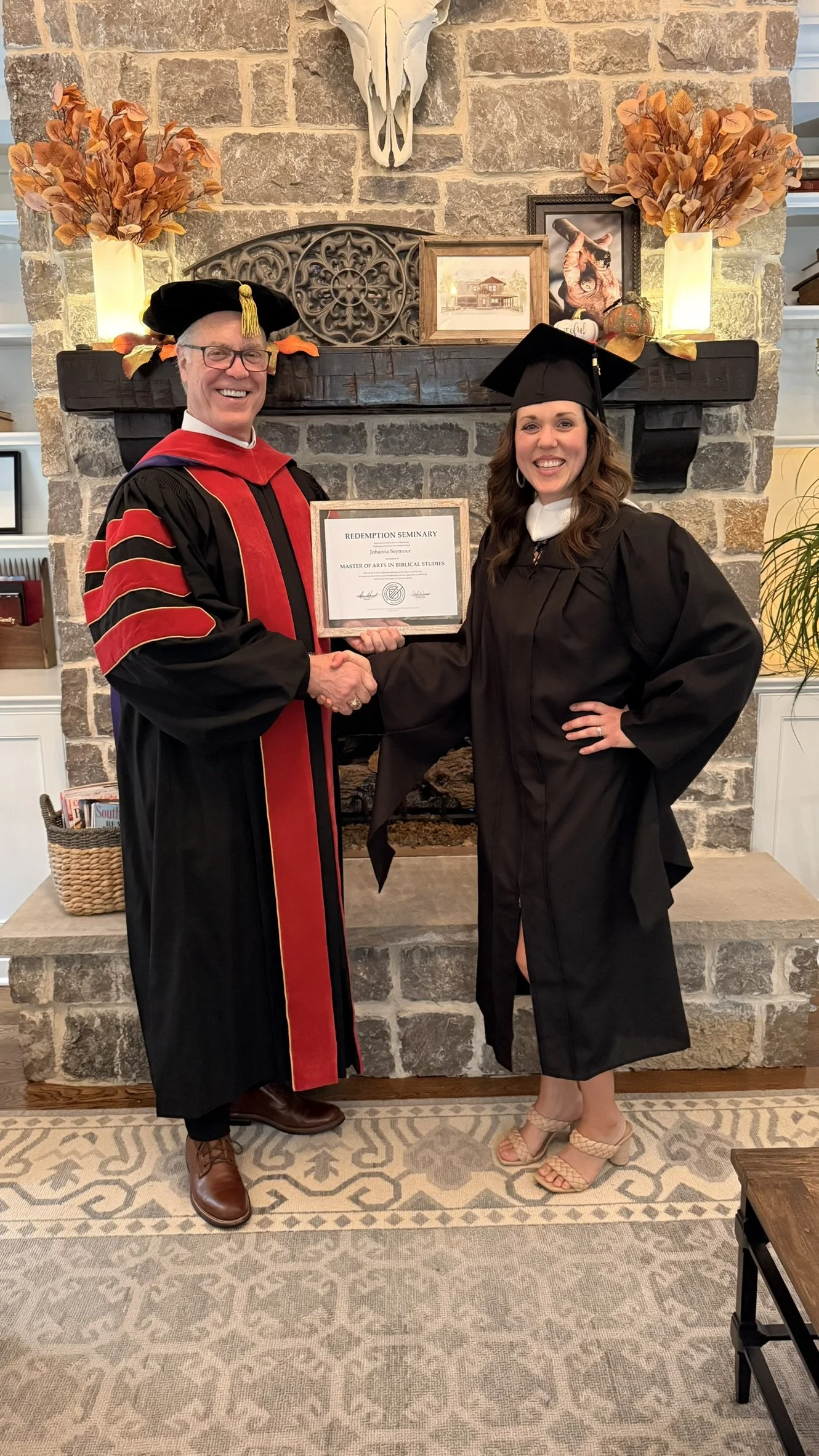
Congratulations to Hanna Seymour!
Hanna graduated with a Master of Arts in Biblical Studies as part of the 2025 graduating class from Redemption Seminary. Hanna is an author, podcast host, and busy mother who is a bright light and a leader in women’s ministries.
Hanna Seymour, M.A. in Biblical Studies graduate · 16-minute interview
-
Hanna explains that teaching Scripture carries significant responsibility. She wanted formal training that would help her handle Scripture carefully and learn from scholars with deeper experience in biblical and theological study.
-
Hanna explains that she began considering Redemption shortly after having her third child. Although theological education had long been part of her plans, she had not expected to pursue it while raising three very young children.
-
Hanna wanted to understand why different Christian traditions interpret certain passages differently. She values being able to describe those positions fairly and converse respectfully about areas where orthodox Christians disagree.
-
Hanna says the program gave her additional tools and resources for exploring theological questions and understanding the major interpretations of difficult biblical passages.
-
Hanna highlights Spiritual Formation for Ministry Leaders because of its emphasis on personal reflection and application. She also describes how another course helped launch the work that eventually became her book Everyday Spiritual Habits.
-
Hanna established consistent study periods in the morning and evening and developed personal deadlines for completing each course. She also deliberately planned breaks around holidays.
-
Hanna preferred completing approximately four weeks of coursework before beginning regular meetings with her mentor-professor. That allowed her to revisit material she had studied earlier rather than encountering everything for the first time during the mentoring term.
-
Hanna reviewed earlier coursework before meeting with her mentor. She found that returning to the material and discussing it again helped reinforce what she had learned and supported longer-term retention.
-
Hanna discusses her plans for continued writing and ministry and the possibility of pursuing a Ph.D. in biblical exposition.
Can seminary fit into an already busy season of life?
When Hanna began considering seminary, she was not looking for something else to fill her schedule.
She had recently had her third child. At the beginning of 2022, she identified three major goals she was considering and prayerfully held them before the Lord, unsure whether she would be able to pursue even one of them. Seminary was one of those possibilities.
Eventually she decided to apply to Redemption.
She already knew that theological education was part of her long-term plan. As an author and Bible teacher, she wanted greater training for the responsibility of teaching Scripture. What surprised her was that she could begin that training during such a demanding season of family life.
“I knew I wanted to pursue a seminary degree just for greater training to help me as I’m writing books and Bible studies and teaching the Bible.”
Why pursue formal biblical training when you are already teaching?
Hanna had already earned undergraduate and graduate degrees and was actively writing and teaching. Her motivation for seminary was not simply adding another credential.
She points to the responsibility Scripture places on teachers. If she was going to open God’s Word and teach others, she wanted to do her due diligence—to be trained by people who had spent years studying Scripture, theology, and biblical interpretation.
For Hanna, graduate theological education provided a structured way to deepen both her knowledge and her ability to know where to turn when difficult interpretive questions arise.
By the end of the program, she says she had many more tools for investigating biblical questions and explaining the major interpretations of challenging passages.
What is it like studying theology in an interdenominational seminary?
Hanna was already accustomed to serving among Christians from different denominational backgrounds. That made Redemption’s interdenominational setting particularly attractive to her.
Rather than simply learning that Christians disagree about a passage or doctrine, she wanted to understand why different Christian traditions reach their conclusions.
That approach also reflects the way she teaches.
Hanna explains that when she encounters a passage with several historic interpretations within orthodox Christianity, she wants to understand and represent those positions fairly—even when she ultimately holds a particular view herself.
For her, learning how Christians can respectfully discuss secondary theological differences was an important part of theological education.
Did seminary actually affect Hanna’s writing and ministry?
Yes—and sometimes in unexpected ways.
One of the courses Hanna continues to reference most frequently is Spiritual Formation for Ministry Leaders. She describes the personal reflection and application in that course as important groundwork for the rest of her studies.
Another course asked her to study the needs of a ministry community and consider an appropriate biblical response. That work directly contributed to the development of her book Everyday Spiritual Habits.
“That class really launched the next book that I wrote.”
For Hanna, coursework did not remain isolated from her existing ministry. What she was studying became material she could use in writing, teaching, discipleship, and her own spiritual formation.
Check out these books written by Hanna.


Watch the Fox News Interview
How did Hanna make time for seminary?
Hanna’s answer is practical: she established a schedule.
She set aside consistent study time in the morning and again in the evening, generally working on coursework about six days each week. With several jobs, children, homeschooling, writing, and ministry responsibilities competing for her time, she learned to determine in advance when the work would happen.
“Once I really figured out when I would do the work and what my personal deadlines would be for each course, it’s kind of just like a paint by numbers.”
She also planned breaks. Instead of expecting seminary work to continue uninterrupted through every season, she deliberately scheduled time away during Christmas and early January.
Her experience illustrates an important feature of Redemption’s model: flexibility does not have to mean working without structure. Students can develop a schedule that fits their responsibilities and then work consistently within it.
Should you complete coursework before meeting with your mentor?
Hanna found a rhythm that worked particularly well for her: working several weeks ahead before beginning regular meetings with her mentor-professor.
“I really like to do four—probably about four weeks—of a course in advance before I actually started meeting with my mentor professor.”
Redemption students have flexibility in how they coordinate self-paced preparation with their eight-week mentoring term. Hanna preferred completing a substantial portion of the course first and then using mentor meetings to revisit material she had already studied.
For her, that separation between preparation and mentoring had an additional benefit.
Can mentor meetings help you retain what you studied?
Hanna discovered that preparing ahead allowed her mentor meetings to function as more than a first exposure to the material.
Before each meeting, she would return to work she had completed several weeks earlier and review it. Then she would discuss that material with her mentor-professor.
That repeated engagement helped reinforce her learning.
“For me, it was a way to kind of reinforce what I had already learned.”
Hanna notes that she has a strong short-term memory, but long-term retention requires more effort. Revisiting material before a mentor conversation gave her another opportunity to retrieve, discuss, and reintegrate what she had studied.
That is one reason she appreciated working ahead: instead of studying a topic and immediately moving on, the mentoring process brought her back to it.
Does flexible online learning mean studying alone?
Hanna’s experience demonstrates the distinction between self-paced preparation and independent learning.
She could determine when to complete her coursework and could prepare several weeks ahead. But that preparation ultimately led into regular conversations with a mentor-professor.
The result was a rhythm of:
Study → review → conversation → reinforcement
Rather than replacing faculty interaction, self-paced preparation gave Hanna material to bring into those conversations.
When she first applied to Redemption, she identified this combination as one of the primary reasons the program appealed to her: the flexibility of self-paced online study combined with the “high-touch” experience of weekly mentoring.
What did completing the degree mean to Hanna and her family?
Hanna’s family and friends marked her graduation in a memorable way.
More than twenty people who had supported her during the program gathered at her home. Hanna wore her graduation regalia, her husband played “Pomp and Circumstance,” and her father—a former Bible college president—put on his own academic regalia and ceremonially presented her diploma.
What began partly as a lighthearted home graduation became an opportunity for Hanna to thank the people who had helped her complete the degree.
She described it simply as:
“Truly one of the best nights of my life.”
The celebration reflected something important about completing graduate education while carrying significant family, work, and ministry responsibilities: although Hanna completed the academic work, many people had encouraged and supported her along the way.
What comes after the M.A.?
Completing the Master of Arts in Biblical Studies was not the end of Hanna’s theological education.
At the time of her graduate interview, she was considering pursuing a Ph.D. in biblical exposition. She also planned to continue writing and teaching, carrying what she learned at Redemption into the ministries she was already pursuing.
Her experience demonstrates what theological education can look like when it is integrated into an existing calling rather than separated from it.
Congratulations to Hanna Seymour!
Congratulations to Hanna Seymour, a member of Redemption Seminary’s 2025 graduating class, on completing her Master of Arts in Biblical Studies.
Hanna pursued theological education while raising a young family, writing, teaching, homeschooling, and serving in ministry. Her disciplined approach to preparation and her intentional use of mentor conversations provide a helpful example of how Redemption’s self-paced, mentor-based model can be incorporated into an already full life.
We look forward to seeing how Hanna continues to use her biblical and theological training through writing, teaching, discipleship, and further study.
Explore your next step
Whether you’re discerning a ministry direction or simply want to study Scripture more deeply, Redemption can help you understand the options available to you.
Considering your first course?
Explore the Master of Arts in Biblical Studies and answers to common admissions questions. Hanna’s story is one graduate’s experience; the program pages explain current requirements and options.